Bitcoin Preferreds and Early Retirement: Testing a Smaller FIRE Number
An early-retirement plan built around Bitcoin, treasury stocks, preferred income, and cash.

If your investments need to cover $4,000 a month, the familiar FIRE calculation gives you a $1.2 million target. Save 25 times your annual expenses, then withdraw 4% of that portfolio in the first year.
FIRE means financial independence, retire early. For someone in their late 30s or 40s, that target can mean another decade or two of work. Bitcoin bulls face the same practical question: how will your investments pay the bills when your paycheck stops?
Preferred shares from Bitcoin treasury companies are one way to try covering bills without selling the growth stack.
Could that combination bring retirement at 50 or 55 closer? Let’s put a smaller portfolio beside the 25 times target and work through the cash flow.
What the 25 times rule assumes
The 25 times target is the inverse of a 4% initial withdrawal:
$48,000 annual spending ÷ 4% = $1.2 million.
The traditional approach adjusts that first withdrawal for inflation in later years. It comes from historical stock-and-bond portfolio research over roughly 30-year retirement periods. It is a planning benchmark, not a guarantee. Bengen’s explanation
Someone retiring at 50 may need the money to last considerably longer. The relevant spending figure is also the amount investments must supply after other income, with taxes and healthcare included in the budget.
The 4% calculation already includes portfolio dividends and interest. Preferred income does not create a second spending allowance on top of the same money.
An $800,000 test case
Meet Alex, a hypothetical 40-year-old aiming to leave full-time work around 55. The target budget is $48,000 annually in today’s purchasing power, including housing, healthcare, and a tax allowance to check against Alex’s actual circumstances.
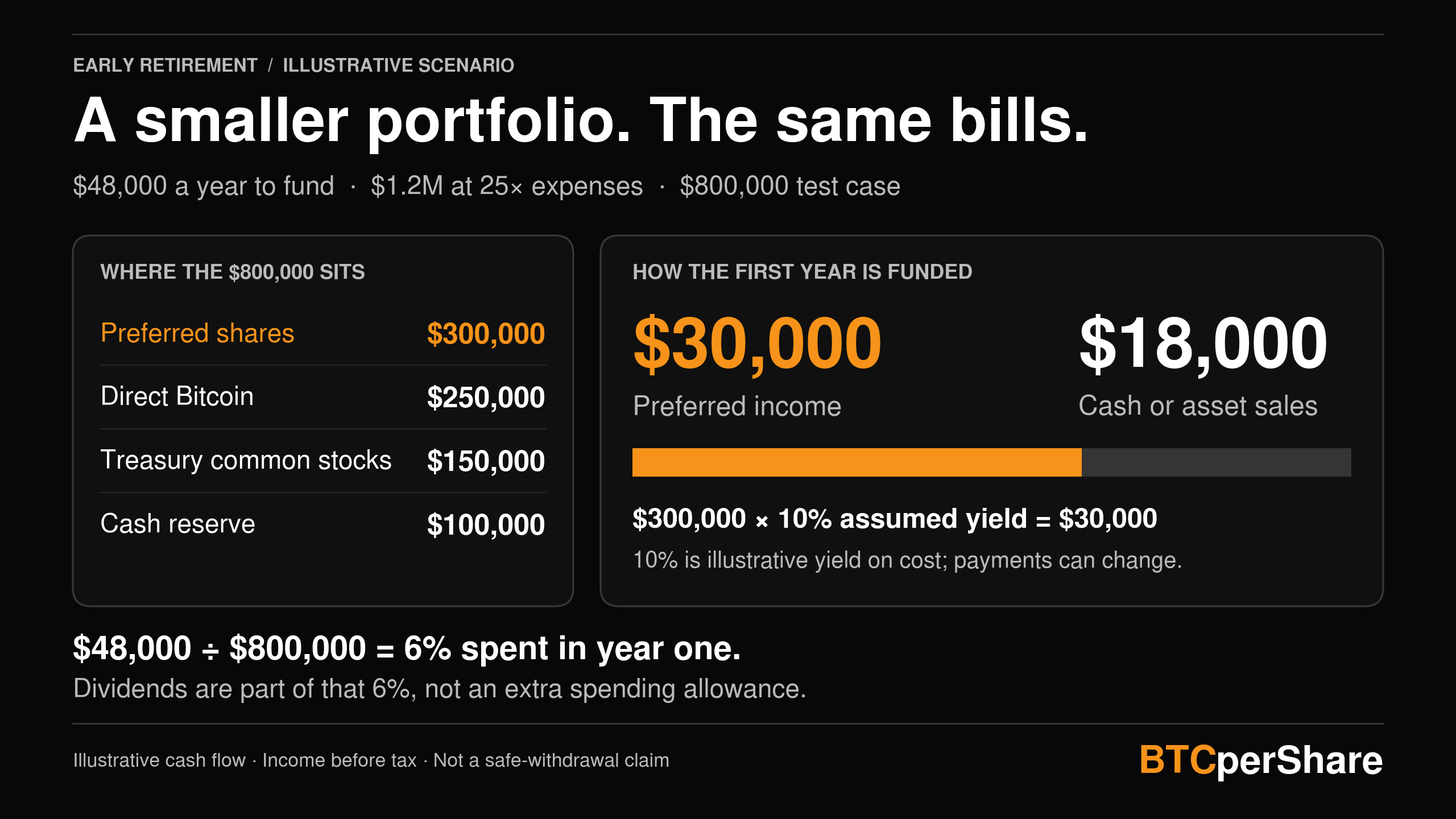
Here is an $800,000 allocation to test against that budget.
The 10% used below is an illustrative annual cash yield on purchase cost, not STRC’s or SATA’s current stated rate or a promised return. Rates and payments can change.
| Holding | Amount | Role |
|---|---|---|
| Preferred shares such as STRC and SATA | $300,000 | Potential cash income |
| Direct Bitcoin | $250,000 | Long-term growth exposure |
| Treasury common stocks such as MSTR and ASST | $150,000 | Potential growth from Bitcoin, backing per share, and valuation |
| Cash | $100,000 | Fund spending gaps and provide flexibility |
| Total | $800,000 | An illustrative allocation, not a recommendation |
At that assumed 10% yield, the preferred position produces $30,000 annually. That covers $2,500 of Alex’s $4,000 monthly budget. The remaining $18,000 comes from cash or asset sales.
The starting portfolio is $400,000 smaller than the 25 times benchmark. But both the distributions and the remaining withdrawals count: Alex is spending 6% of the entire $800,000 portfolio in year one. The income source does not change that arithmetic.
The $800,000 includes the preferreds; no additional retirement account is assumed.
How many working years separate the targets
Suppose Alex currently has $150,000 invested and adds $2,000 at the end of each month. To isolate the difference between the targets, assume the same smooth 5% annual return after inflation, taxes, and fees for both savings paths. Contributions rise with inflation so their purchasing power stays constant.
| Target in today’s purchasing power | Approximate age reached |
|---|---|
| $800,000 | 54.4 |
| $1.2 million | 59.9 |
That is about 5½ years between the targets. Under the same assumptions, Alex reaches approximately $553,000 at 50 and $841,000 at 55.
Reaching a lower viable target could mean years of additional freedom. This is an illustrative savings path, not the retirement portfolio’s expected return or proof Alex can retire at 54.
For this illustration, all funds are assumed accessible. Actual 401(k) and IRA balances require a separate withdrawal-access plan.
What preferred income can cover
Here’s the cash math. Keep the preferred purchase cost at $300,000 and the first-year budget at $48,000:
| Assumed cash yield on purchase cost | Annual income | Monthly equivalent | Remaining annual gap |
|---|---|---|---|
| 12% | $36,000 | $3,000 | $12,000 |
| 10% | $30,000 | $2,500 | $18,000 |
| 8% | $24,000 | $2,000 | $24,000 |
| 6% | $18,000 | $1,500 | $30,000 |
| No distributions paid during the year | $0 | $0 | $48,000 |
These are before-tax income assumptions, not forecasts or a statement that either issuer can freely move its rate to every level shown. The table excludes cash interest and assumes no preferred sales.
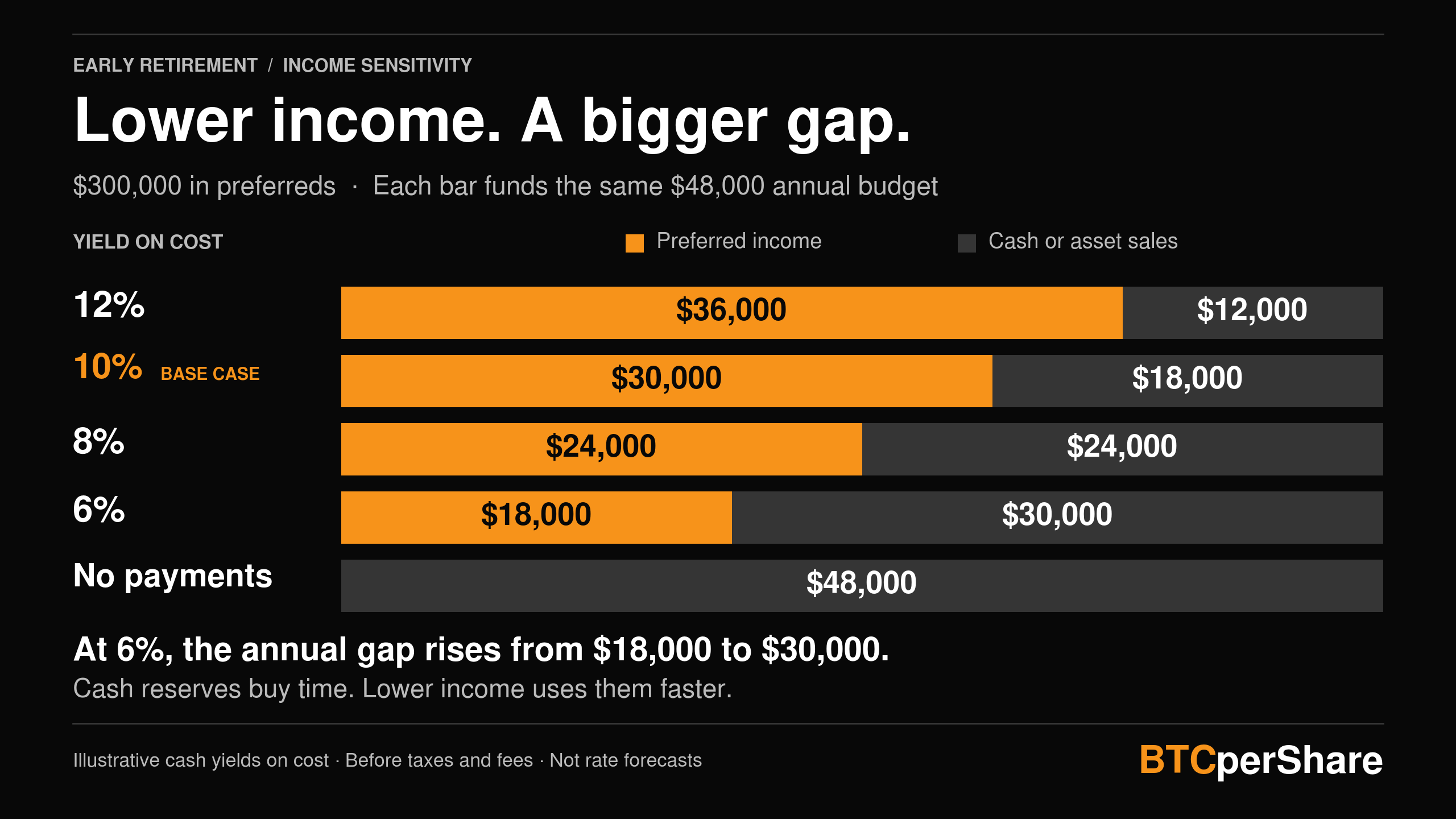
At 10%, the cash reserve could cover the initial $18,000 gap for about 5.6 years if spending and income never changed and cash earned nothing. Inflation shortens that period. At 2.5% annual inflation, the spending budget rises about 34.5% over twelve years, while a fixed dollar distribution buys progressively less.
Use the preferred income calculator to test purchase prices, quantities, and dividend assumptions. Our STRC and SATA income guide explains why the stated dividend rate and your yield on cost can differ.
Why keep Bitcoin and treasury stocks
The $400,000 growth allocation gives Alex exposure to potential appreciation that could help replenish reserves and support spending later in retirement. Its value can also fall sharply.
Treasury stocks add another variable: the Bitcoin backing each share can change. Successful capital allocation may grow that backing, while a shrinking market premium can offset the benefit. Our treasury-stock guide explains the investment case; the stock-versus-Bitcoin calculator lets you vary backing growth and valuation.
Buying preferreds by selling existing Bitcoin reduces that Bitcoin position and may create a tax bill. Later distributions could reduce the need for further sales.
- Concentration risk: With STRC/SATA preferreds and MSTR/ASST common, more than half the portfolio ($450,000) depends on just two issuers in the same Bitcoin treasury ecosystem. Dividend risk and common-stock losses could hit together, alongside losses on the $250,000 of direct Bitcoin.
Our preferred-financing guide explains how these claims fit together and what financing obligations sit behind the income.
Build the bridge around actual retirement dates
For U.S. readers, leaving work at 55 creates several gaps. Under current rules, 59½ is the general early-distribution tax threshold for retirement accounts. A qualifying employer-plan exception can apply when separation occurs during or after the year you turn 55; it does not apply to IRAs.
Ordinary income tax and plan access still matter. IRS withdrawal rules
Social Security retirement benefits can begin at 62 with a reduction; full retirement age is 67 for this audience. Estimate benefits using the intended stop-work age, since leaving work earlier can reduce the amount. SSA ages · SSA earnings guidance
Medicare generally starts at 65. Budget for healthcare before then. Medicare eligibility
Those later benefits can ease the spending burden. Alex still needs assets to fund the years after the bridge.
Test the years when the plan is under pressure
Suppose the $400,000 growth allocation falls 50% near retirement and preferred income is only $18,000. The initial spending gap becomes $30,000: 15% of the now-$200,000 growth allocation if funded entirely by selling those assets. Cash can delay those sales, but it is finite.
Preferred prices can also decline, including while distributions continue. Strategy explicitly says STRC cash dividends are not guaranteed and its preferred securities are not collateralized by its Bitcoin holdings. STRC disclosures
For perspective, assume zero growth-asset appreciation, zero cash interest, unchanged preferred prices, and spending rising 2.5% annually. Across twelve retirement years, the $800,000 example would finish with approximately $498,000 if preferred income stayed at $30,000 annually, or $354,000 if it stayed at $18,000. Those are nominal ending balances, with the $300,000 preferred position retained in both cases. Taxes beyond the budget allowance, fees, and other income are excluded. These simplified calculations show capital being consumed; they do not establish lifetime sustainability.
Taxes can change the comparison. In a taxable account, preferred distributions taxed as nonqualified dividends can push Alex into a higher ordinary-income bracket; selling Bitcoin held for more than a year generally taxes only the gain, potentially at a lower long-term capital-gains rate. Qualified dividends receive different treatment, so check the actual distribution classification. IRS dividends · IRS capital gains
Return-of-capital distributions generally reduce cost basis; amounts beyond a zero basis can create capital gains. They should not be treated as permanently tax-free income. The 59½ withdrawal threshold does not determine how taxable-account dividends or Bitcoin gains are classified.
Put your own retirement date into the plan
The Bitcoin retirement planner connects holdings, contributions, spending, growth assumptions, and preferred income. Compare age 50 with 55, then reduce the income and growth assumptions. Use the portfolio exposure calculator separately to distinguish direct Bitcoin from gross and net backing represented by common shares.
The planner holds preferred prices and payments constant and excludes taxes and fees. It starts entered “other retirement income” when retirement begins, so later Social Security benefits need a separate calculation. The examples here are independently calculated illustrations.
Preferred income could help buy back working years. The opportunity is to cover more of the near-term budget while keeping meaningful Bitcoin exposure. That only works if income, cash, and the growth sleeve survive a bad stretch without forcing sales at the wrong time.
Educational scenarios, not personalized investment advice. Starting amounts and savings targets use today’s purchasing power. Savings use monthly compounding equivalent to 5% annually, with end-of-month contributions. The twelve-year example rebases amounts to retirement-start dollars, then uses nominal annual cash flows: distributions, cash, and growth-asset sales fund spending in that order. No contributions, rebalancing, or equal-risk comparison is assumed.