How Preferred Stock Can Finance Bitcoin Purchases
Preferred equity can help a Bitcoin treasury company raise capital without immediately increasing its common-share count. But the capital isn't free—and the full shareholder outcome depends on BTC/share, amplification and the cost of the preferred layer.
More Bitcoin without immediate common dilution?
A non-convertible preferred can raise capital without directly adding common shares. The trade-off is a new preferred claim, dividend obligation and more amplification.
For a Bitcoin treasury company, acquiring more Bitcoin is only half the equation. The other half is how the Bitcoin was financed. A company can use cash, borrow money, issue common stock, or raise capital through preferred equity. Each method can increase Bitcoin holdings, but each can produce a very different outcome for common shareholders.
That is why simply asking whether a company owns more Bitcoin can be misleading. The better question is whether the financing increased the amount of Bitcoin attributable to each common share—and what it cost to accomplish that.
Did the financing increase BTC/share, and what obligation was created to produce that increase?
Preferred stock has become an important part of that equation for Bitcoin treasury companies such as Strategy and Strive. Properly structured, preferred equity can provide substantial capital without immediately adding shares to the common-stock denominator. It can also create a senior capital claim, an ongoing dividend obligation and greater financial amplification. Understanding the whole cycle is essential.
The Bitcoin treasury financing problem
Imagine a Bitcoin treasury company owns 10,000 BTC and has 100 million common shares. Its Bitcoin per share is 0.0001 BTC, or 10,000 sats/share. Now suppose it wants to acquire another $100 million of Bitcoin. Where does that $100 million come from?
The company could issue common stock. If it can sell that stock at an attractive valuation relative to its Bitcoin holdings, the transaction could still be accretive to BTC/share, but issuing common shares increases the denominator. If the company instead raises the money through a non-convertible preferred security, it can receive capital and deploy it into Bitcoin without necessarily increasing the number of common shares outstanding.
That creates the possibility for BTC/share to increase. But it also creates something else: a preferred claim that must now be supported by the company's capital structure.
What is preferred stock?
Preferred stock sits somewhere between traditional common equity and debt. The exact terms vary substantially from security to security, but preferred holders can receive economic preferences over common shareholders, including stated dividends, priority for distributions, liquidation preferences, redemption provisions or conversion rights.
For a Bitcoin treasury company, however, one of the most important questions is what the preferred security can ultimately become. Some preferreds can convert into common stock; others cannot. A non-convertible preferred can raise capital without directly increasing the common-share denominator, while a convertible preferred may eventually result in additional common shares.
Preferred does not automatically mean non-dilutive.
You have to read the security. Strategy's STRC, for example, has no conversion privilege, while Strategy's STRK is convertible into Class A common stock. That difference matters when evaluating BTC/share.
Why preferred financing can increase BTC/share
Suppose a company raises $100 million through a non-convertible preferred and uses the proceeds to acquire Bitcoin. Bitcoin holdings increase, but the common-share denominator does not necessarily increase as a direct result of that preferred issuance. If nothing else changes, BTC/share can rise.
This is one reason preferred financing can be attractive to a Bitcoin treasury company. But stopping the analysis there would be a mistake because the preferred stock has created a new economic obligation.
For a deeper explanation of the numerator and denominator, see What Is Bitcoin Per Share? →
The cost of capital doesn't disappear
Suppose a company issues $100 million of preferred stock carrying a 12% annual dividend rate. It now has $100 million of preferred stated amount and roughly $12 million of annualized dividend obligation at that rate. If the proceeds were used to acquire Bitcoin, BTC/share may have improved, but the company now has to support that preferred layer.
Preferred financing can move dilution out of the common-share denominator, but it does not make the cost of capital disappear.
Instead of paying for capital primarily through immediate common-share issuance, the company may be taking on a recurring preferred obligation. That's why we want to know not only how much capital was raised and how much Bitcoin was acquired, but also what happened to BTC/share, how much preferred capital was created, what the annual dividend obligation is, and how much amplification the transaction added.
Preferred equity and Bitcoin amplification
Preferred financing introduces another important concept: Bitcoin amplification. Strive has defined its Bitcoin amplification ratio as notional preferred equity outstanding plus debt divided by Bitcoin NAV. Strive currently has no debt and has described its balance sheet as using preferred-equity-only amplification.
If a company raises additional preferred capital while Bitcoin NAV is unchanged, amplification increases. If that capital is subsequently deployed into Bitcoin, Bitcoin NAV can increase as well. Amplification therefore isn't inherently good or bad; it tells us how much senior or preferred capital is being used relative to the Bitcoin treasury supporting the capital structure.
The important question is what management accomplishes with that amplification. Two companies could produce identical BTC/share growth while using very different amounts of preferred capital to get there. The BTC/share result might look similar. The capital structure underneath it is not.
STRC: preferred equity as a Bitcoin financing engine
Strategy provides one of the clearest examples. In July 2025, it issued 28,011,111 STRC shares at $90 per share, generating approximately $2.521 billion of gross proceeds and about $2.474 billion of estimated net proceeds. Strategy said it intended to use the proceeds for general corporate purposes, including acquiring Bitcoin.
STRC carries a $100 stated amount, initially carried a 9% annual dividend rate, and has no conversion privilege. By September 2026, Strategy's regular STRC dividend rate had reached 12% annually. That structure gives Strategy another source of capital without directly issuing additional MSTR common shares, but every STRC share outstanding also represents preferred stated amount and an associated dividend burden.
The financing engine can also run in reverse
Preferred financing doesn't have to be a one-way process. Strategy has recently been repurchasing STRC while it trades below its $100 stated amount, showing how management can also retire preferred capital when the economics are attractive.
Consider a simplified example. If a company can repurchase and retire $100 of preferred stated amount for $95, it spends $95 to eliminate a $100 preferred claim. At a 12% annual dividend rate, it also eliminates roughly $12 per year of annualized dividend obligation attached to that $100 of stated amount.
The example is intentionally simplified, but it shows why the market price of the preferred itself matters. Issuance price matters on the way in; repurchase price matters on the way out.
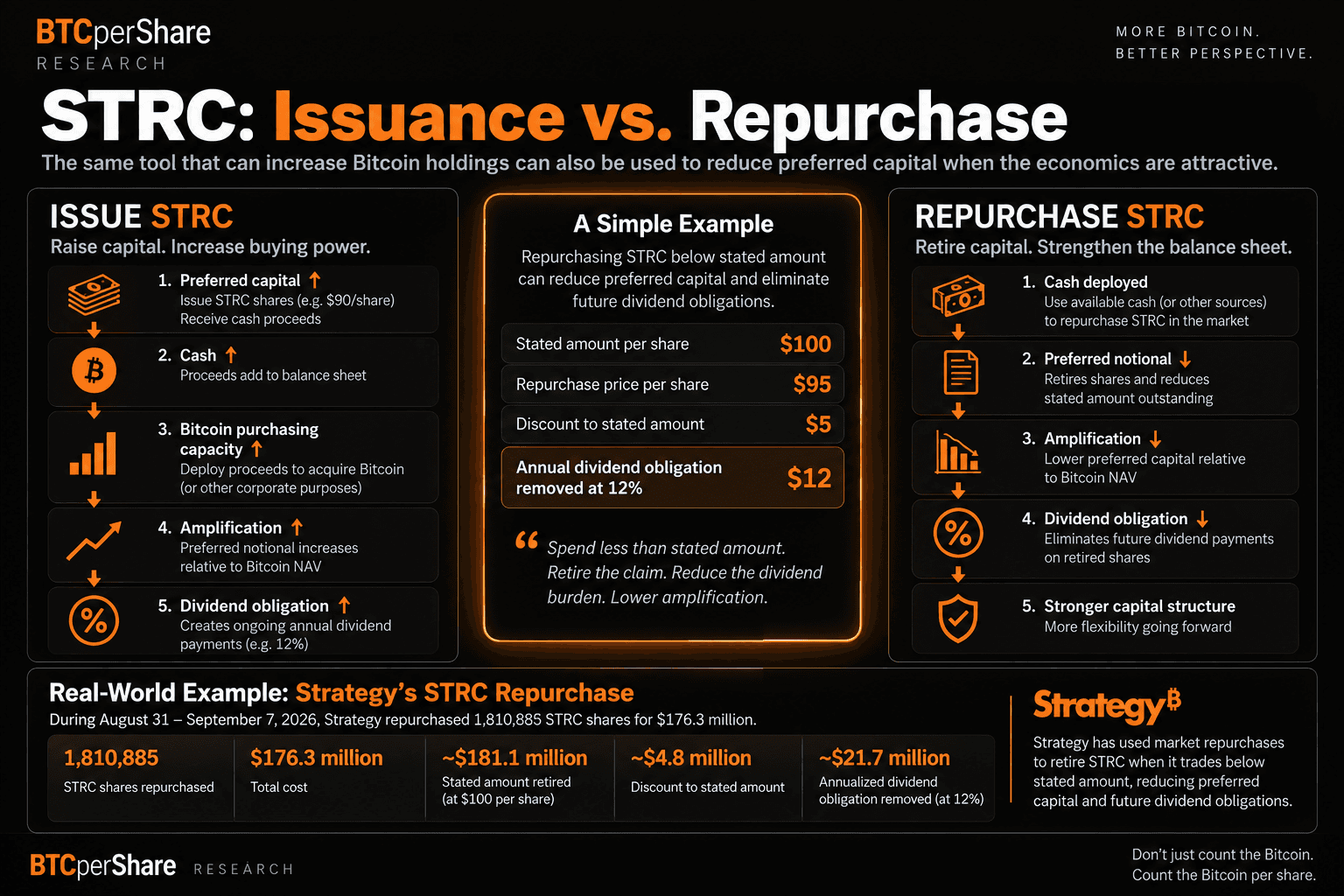
Strategy is doing this with STRC today
During August 31 through September 7, 2026, Strategy repurchased 1,810,885 STRC shares for $176.3 million. Those shares represented about $181.1 million of stated amount, meaning Strategy retired the claim for roughly $4.8 million less than stated amount before considering other transaction economics.
At a 12% annual dividend rate, retiring those 1,810,885 shares removes roughly $21.7 million of annualized dividend obligation at the current rate. The same mechanism that increases amplification when preferred stock is issued therefore works in reverse when preferred stock is retired.
That can strengthen the capital structure, but there is another question BTC/share investors need to ask.
The source of the repurchase capital matters.
What paid for the repurchase?
A preferred repurchase can look attractive in isolation, but the full shareholder outcome depends on how it was funded. If a company retires $100 million of preferred stock for $95 million but has to sell $95 million of Bitcoin to do it, both the preferred claim and the Bitcoin treasury decline. If it issues common stock instead, the preferred layer may shrink while the common-share denominator grows.
Strategy's recent disclosures illustrate why the distinction matters. For August 10–16, it reported using MSTR ATM proceeds to fund STRC dividends and $132.2 million of STRC repurchases. During August 31–September 7, it reported using USD cash for $176.3 million of STRC repurchases. The repurchase price alone doesn't tell us the shareholder outcome.
We need to know what was retired, what it cost, how it was funded, and what happened to Bitcoin holdings, the common-share denominator and amplification. That's the complete transaction.
SATA: another approach to preferred amplification
Strive provides another useful case study through its Variable Rate Series A Perpetual Preferred Stock, or SATA. SATA has a $100 stated amount, and Strive raised its dividend rate to 13% annually in April 2026. The company has described its capital structure as using preferred-equity-only amplification after eliminating its remaining debt.
As of September 4, 2026, Strive reported 9,995,425 SATA shares outstanding and 24,531 BTC. At $100 of stated amount per SATA share, that represents approximately $999.5 million of SATA stated amount. At a 13% annual rate, it implies approximately $129.9 million of annualized SATA dividend obligation at the current rate.
That's a substantial financing layer, and it demonstrates why looking only at Strive's Bitcoin holdings is incomplete. The preferred capital can create a larger financing engine, but that engine comes with an ongoing economic cost.
Did the common shareholder actually benefit?
This brings us back to Bitcoin per share. In Strive's September 8 disclosure, the company reported purchasing another 1,375 BTC during August 31 through September 4. Our BTCperShare analysis showed Bitcoin holdings increased 5.94%, effective common shares increased 1.79%, and BTC/share increased 4.07%.
Bitcoin grew faster than the common-share denominator, so BTC/share increased. That's an important shareholder outcome, but it still doesn't tell the whole story. We should also ask how much preferred capital sits behind the strategy and what maintaining that capital costs.
BTC/share and amplification measure different things
BTC/share asks how much Bitcoin there is relative to a specified common-share denominator. Amplification asks how much preferred capital and debt are supporting the Bitcoin treasury relative to Bitcoin NAV. A company can therefore increase BTC/share while simultaneously increasing amplification.
That isn't contradictory. It means the company increased the Bitcoin backing of each common share while also increasing the amount of senior or preferred capital supporting the treasury. Likewise, a company can reduce amplification by repurchasing preferred stock, but the BTC/share outcome depends on what it used to fund that repurchase.
Common-share Bitcoin exposure
Capital-structure intensity
Annualized financing burden

A better way to analyze preferred-financed Bitcoin purchases
When a Bitcoin treasury company issues preferred stock, one of the first things to understand is where the proceeds are actually going. Preferred capital can serve several purposes, and it is a mistake to assume that every dollar raised is immediately converted into Bitcoin. Depending on the company and the market environment, proceeds can be used to buy Bitcoin, increase cash or dividend reserves, meet preferred dividend obligations, or repurchase common stock.
Increase the treasury and potentially BTC/share.
Add liquidity and support future preferred obligations.
Meet the ongoing cost of the preferred capital already outstanding.
Reduce the common-share denominator when management believes the economics are attractive.
Where the money goes is only part of the analysis. We also want to understand what the issuance does to amplification and future dividend obligations, and how management intends to manage those obligations through a full Bitcoin market cycle. Issuing more preferred can increase amplification and create more purchasing capacity, while retaining cash can strengthen the dividend reserve. Later, preferred repurchases can reduce both amplification and the annualized dividend burden. These decisions are connected rather than isolated transactions.
Strive has described its preferred equity as a “Bitcoin amplification toggle”—a tool designed to let the company increase or decrease amplification as market conditions change. That idea becomes especially interesting around the Bitcoin cycle. The Strive team has discussed using greater amplification when Bitcoin is closer to long-term valuation levels such as its 200-week moving average—in other words, when Bitcoin may be closer to the later stages of a bear market—rather than treating amplification as a static number that should remain constant forever.
Preferred financing isn't just a way to buy more Bitcoin. It can be a tool for actively managing a Bitcoin treasury through the cycle.
That active management is also one of the fundamental differences between owning common stock in a Bitcoin treasury company and simply owning a spot Bitcoin ETF. An ETF gives an investor relatively direct Bitcoin exposure. A treasury company adds a management team and a capital structure that can issue securities, build reserves, repurchase common or preferred shares, and change amplification as opportunities emerge. Those additional tools can create opportunities to grow BTC/share, but they also introduce financing costs, execution risk and management risk that an investor needs to evaluate.
For BTCperShare, that's the framework: don't just ask whether preferred stock was issued. Follow the proceeds, measure the new obligation, understand the change in amplification, and then watch how management uses those tools over the Bitcoin cycle.

The preferred financing lifecycle
Was the increase in Bitcoin per share worth the capital required to produce it?
Preferred stock is a tool, not a free lunch
Preferred stock gives Bitcoin treasury companies another way to access capital. Used effectively, a non-convertible preferred can allow a company to raise substantial amounts of money without immediately increasing its common-share denominator, and that capital can help acquire Bitcoin and potentially increase BTC/share.
At the same time, preferred claims, dividend obligations and amplification increase. Later, management may have opportunities to reverse some of that amplification by repurchasing preferred stock—potentially below stated amount—and reducing both the preferred claim and its associated dividend burden. Whether that creates a favorable shareholder outcome depends on the repurchase price and, critically, what funded the transaction.
This is why measuring Bitcoin treasury companies requires more than counting Bitcoin. We need to follow the capital from issuance, through Bitcoin acquisition, through the BTC/share result, and eventually through the servicing or retirement of the financing.
Don't just count the Bitcoin. Count the Bitcoin per share—and understand what it cost to get there.
Frequently asked questions
How can preferred stock finance Bitcoin purchases?
A company can issue preferred stock for cash and use some or all of the proceeds to acquire Bitcoin. A non-convertible preferred can do this without directly increasing the common-share denominator, although it creates preferred claims and dividend obligations.
Does preferred stock dilute common shareholders?
Not automatically. Non-convertible preferred stock does not directly add common shares, while convertible preferred stock may create future common shares depending on its terms.
What is Bitcoin amplification?
Bitcoin amplification compares preferred equity and debt with the value of a company's Bitcoin treasury. In this guide, BTCperShare uses the framework disclosed by Strive: notional preferred equity outstanding plus debt divided by Bitcoin NAV.
Why do preferred dividend obligations matter?
Preferred financing has an ongoing cost. A larger preferred balance can create larger dividend obligations, so BTC/share growth should be considered alongside the cost and seniority of the capital used to produce it.
Why would a company repurchase preferred stock below stated amount?
Repurchasing preferred below stated amount can retire more preferred notional than the cash spent and eliminate the associated future dividend obligation. The overall outcome still depends on how the repurchase is funded.
Methodology & sources
BTCperShare evaluates preferred securities using company disclosures and SEC filings. Preferred terms can differ materially between securities, including dividend rates, conversion rights, liquidation preferences, redemption provisions and seniority. BTC/share and amplification answer different questions and should not be treated as interchangeable measures.
Bitcoin amplification in this guide follows the framework disclosed by Strive: notional preferred equity outstanding plus debt divided by Bitcoin NAV. Annualized preferred dividend obligations shown here are calculations based on stated amount outstanding multiplied by the applicable annual dividend rate; actual dividends remain subject to the governing security terms and company declarations.
Primary sources: Strategy STRC pricing disclosure · Strategy Sep. 8, 2026 8-K · Strategy Aug. 17, 2026 8-K · Strive Sep. 8, 2026 8-K · Strive SATA financing framework.
This guide is for informational purposes only and is not investment advice.