Why Buy a Bitcoin Treasury Stock Instead of Bitcoin?
Comparing direct Bitcoin, spot ETFs, and treasury companies—and how Bitcoin-per-share growth changes the equation.

If you’re bullish on Bitcoin, why buy shares in a company that owns it? Especially when those shares trade at a premium to the underlying Bitcoin?
The appeal is that the amount of Bitcoin represented by each share can grow. A successful treasury company can raise and deploy capital in ways that increase Bitcoin per share, giving an investor more underlying Bitcoin backing without buying additional shares.
That is an opportunity, not a guaranteed advantage. What matters is how the growth is financed, what obligations come with it, and how much future success the stock price already reflects. Buying a treasury stock means making a judgment about management and valuation alongside your view on Bitcoin.
Three ways to get Bitcoin exposure
Direct Bitcoin, spot Bitcoin ETFs, and treasury common stocks offer different ownership structures.
| Route | What you own | Main appeal | Main trade-off |
|---|---|---|---|
| Direct Bitcoin | Bitcoin, held yourself or through a custodian | Direct exposure and, with self-custody, control of the asset | Responsibility for custody arrangements and security |
| Spot Bitcoin ETF | Shares in a vehicle holding Bitcoin | Convenient exposure through a brokerage account | Fund expenses and reliance on intermediaries |
| Treasury common stock | Equity in a company that holds Bitcoin | Potential growth in Bitcoin backing per share | Financing obligations, corporate costs, dilution, and changing valuation |
If you buy and hold 0.5 BTC, its dollar value can change dramatically, but the quantity remains 0.5 BTC. Holding it does not automatically produce additional Bitcoin.
A spot ETF offers brokerage exposure without requiring you to manage private keys. It still relies on institutional custody, and expenses reduce the assets attributable to each share over time. IBIT, for example, lists a 0.25% annual sponsor fee. IBIT fund information, custody and operating disclosures
A treasury company adds active capital allocation. Management’s decisions can increase—or decrease—the amount of Bitcoin represented by each share.
How active management can increase BTC/share
Think of management as a team allocating capital on behalf of shareholders. It decides when to issue common shares, raise other financing, buy Bitcoin, maintain cash, or retire securities. Those decisions change both sides of the calculation:
Bitcoin per share = Bitcoin held ÷ the relevant share count
When a company issues shares to buy Bitcoin, its holdings must grow faster than the share count for BTC/share to increase. If both double, each share represents exactly as much Bitcoin as before.
This explains why issuing shares at a premium can benefit existing shareholders. Imagine a company with 100 BTC and 100 shares: each share represents 1 BTC of gross holdings. If investors will pay the equivalent of 2 BTC for a new share, the company can issue 10 shares and buy 20 BTC with the proceeds.
The result is 120 BTC spread across 110 shares, increasing Bitcoin per share from 1 BTC to approximately 1.091 BTC. An investor who owned one share still owns one share, but it now represents about 9.1% more Bitcoin.
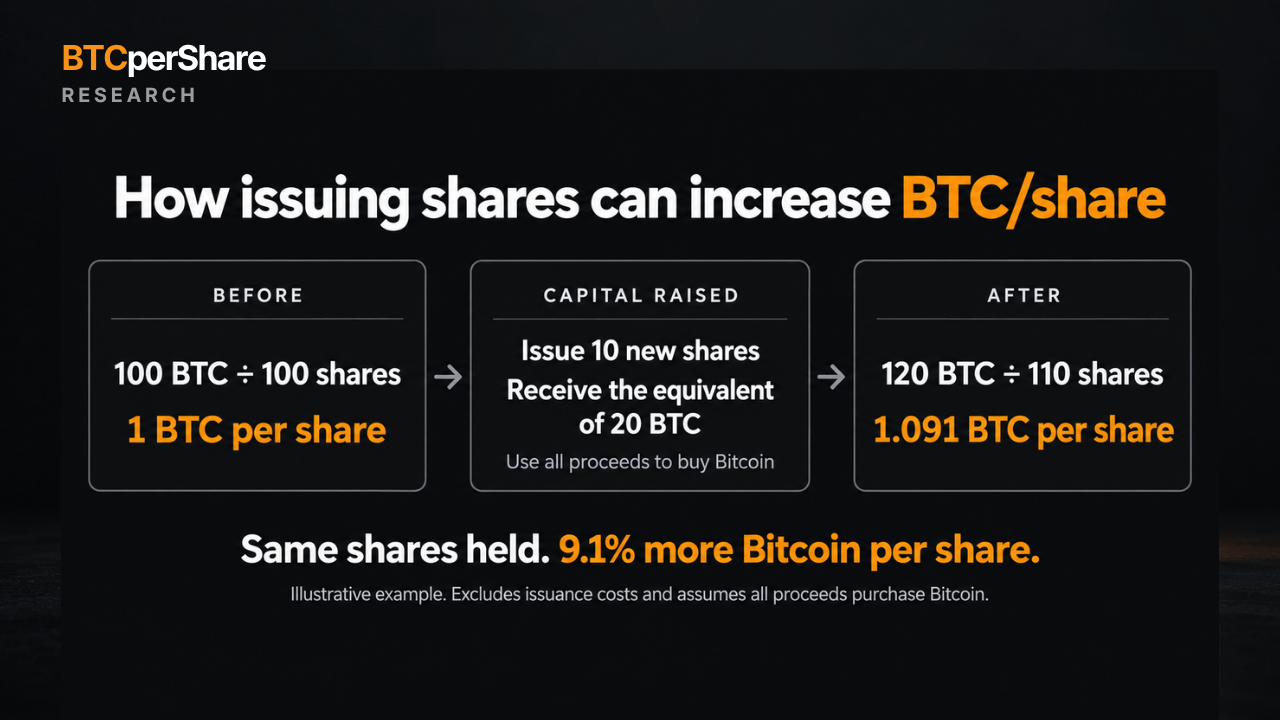
That is an issuance described as accretive to BTC/share. The company acquires more Bitcoin per new share than each existing share represented before the transaction. The actual benefit depends on the issuance price, expenses, and how much of the proceeds goes toward buying Bitcoin.
How the growth is financed matters
A company can also increase gross BTC/share by taking on debt or issuing preferred stock. That adds obligations alongside the additional Bitcoin.
Return to the company with 100 BTC and 100 shares. Suppose it borrows enough dollars to buy 20 BTC without issuing common shares. Gross BTC/share rises to 1.2 BTC. At that moment, however, the extra 20 BTC is offset by an equal amount of debt when both are valued at the same Bitcoin price. Net backing has not increased before costs, even though gross BTC/share has.
The financing creates greater exposure to future Bitcoin price movements. Dollar obligations do not automatically shrink when Bitcoin falls, and interest or preferred dividends must be considered. Strategy explicitly warns that its gross Bitcoin metrics can increase while claims ahead of common shareholders also increase. Strategy’s KPI disclosures
Two measurements help separate these effects:
- Gross BTC/share: Bitcoin held divided by the selected share count.
- Net Bitcoin-equivalent backing: An estimate that adjusts for specified financial assets and claims ahead of common equity.
CEBE expresses estimated net common-equity backing in Bitcoin terms by adjusting for debt, preferred claims, and cash. Its result depends on the inputs, share count, and Bitcoin price used. It is not a complete business valuation or a guaranteed liquidation value. CEBE framework
The CEBE calculator provides that additional perspective. Read its dated inputs and exclusions alongside the result; a gross BTC/share growth rate should not automatically become a forecast for net backing.
What a fixed share position can show
Historical charts make BTC/share easier to understand: keep the investor’s share count constant and measure how its associated Bitcoin backing changes.
The following snapshots show gross backing rather than investment returns. Both use company-specific assumed diluted share measures, with different observation periods and definitions. Neither accounts for all senior claims, and neither represents a right to withdraw company-held Bitcoin.
Strategy: long-term growth with reversals
.png)
The chart shows 100 MSTR shares moving from approximately 0.05660 BTC equivalent to 0.18774 BTC equivalent, an increase of 231.7% over the displayed period. It also shows a decline after earlier gains in 2026.
Both observations matter. Management has a substantial history of increasing gross backing per share, but that growth has not followed a smooth or uninterrupted path. Underlying share data, September 14 holdings disclosure
Strive: growth over a shorter history
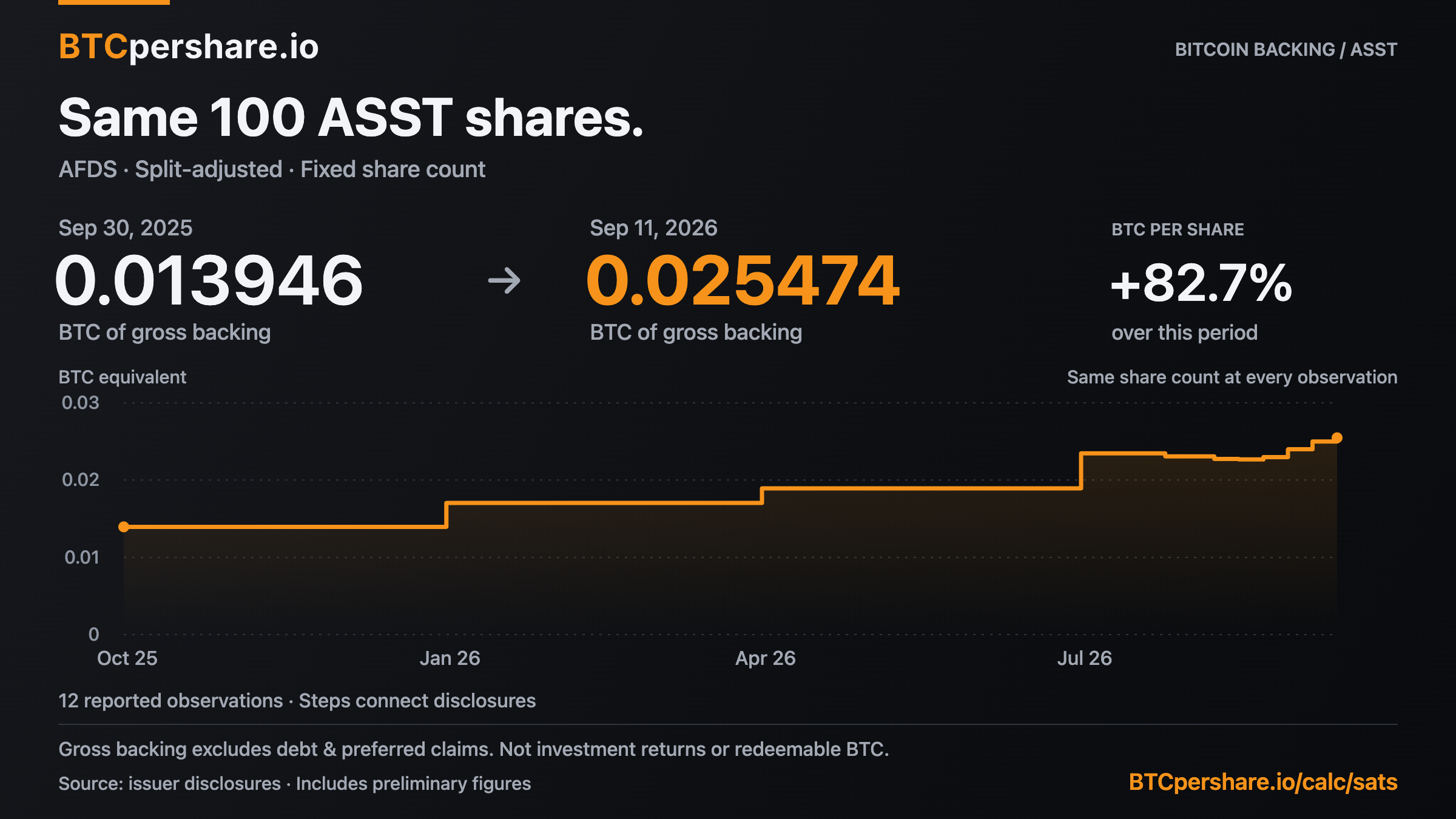
The chart shows 100 ASST shares moving from approximately 0.01395 BTC equivalent to 0.02547 BTC equivalent, an increase of 82.7% over the displayed period. This is cumulative growth across the chart’s dates, not an annual forecast. The starting metric appears in Strive’s historical quarterly table; the ending ratio uses its September 11 Bitcoin holdings and AFDS count. Historical table, September 14 disclosure and share definitions
The 100-share examples illustrate each company’s history. They are not equal-dollar investments, and a larger Bitcoin equivalent does not establish which stock offers better value.
How much growth are you already paying for?
A good accumulation record does not make a treasury stock attractive at every price.
The premium is a market valuation, not a management fee paid to the company when you buy existing shares. It may reflect expectations for future growth, financing access, and other business value. Investors can later assign a much smaller premium—or a discount.
To isolate that effect, use a simple multiple:
Stock price ÷ the market value of gross Bitcoin per share
Be careful when comparing this with a quoted mNAV. Definitions vary. Strategy’s current mNAV, for example, uses net Bitcoin backing, so it is not interchangeable with this gross-backing illustration. Strategy’s valuation definitions
Suppose you buy a stock at 2× gross Bitcoin backing. BTC/share subsequently grows 20%, but the stock’s multiple falls to 1.5×. Its value relative to an equal initial investment in Bitcoin changes by:
1.20 × (1.5 ÷ 2.0) = 0.90
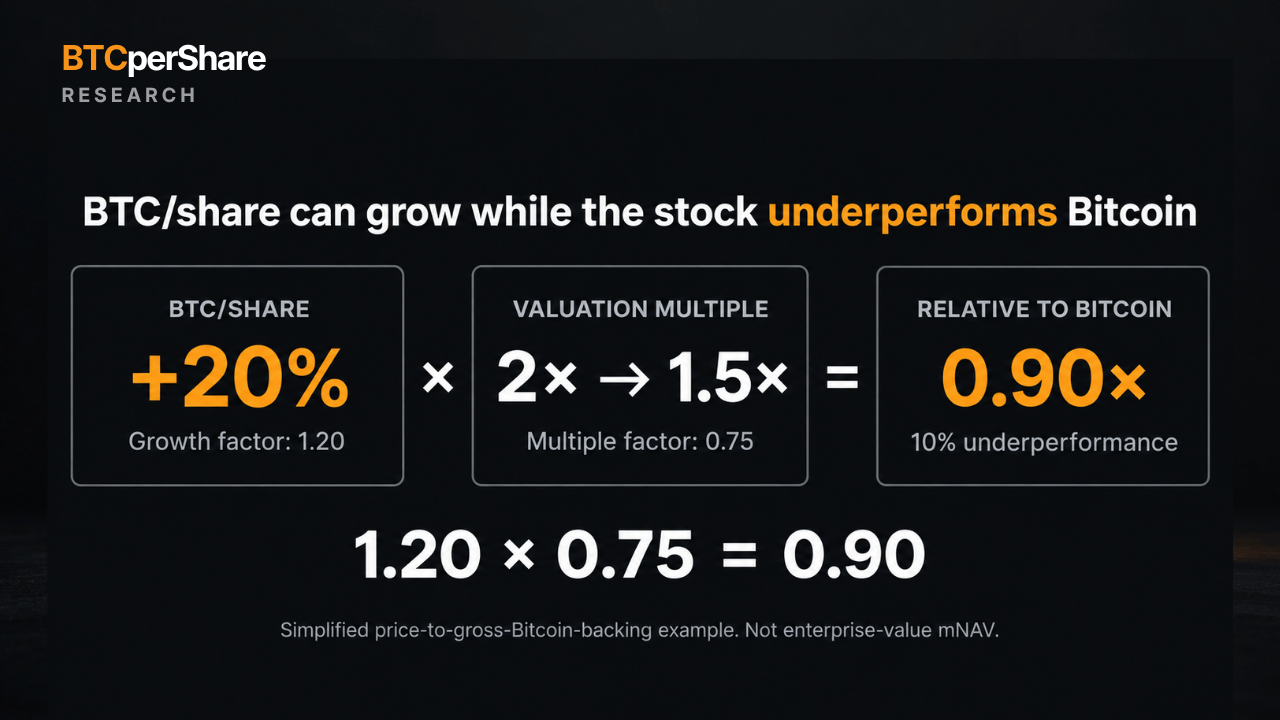
The stock position ends worth 90% of the comparable Bitcoin position. That is 10% underperformance relative to Bitcoin, not necessarily a 10% dollar loss. If Bitcoin doubled, for example, the stock would rise 80% under these assumptions.
BTC/share would need to grow 33.3% to offset the move from 2× to 1.5×. That is a cumulative break-even hurdle, not an annual growth estimate. The illustration excludes investor taxes, trading costs, and common-stock distributions.
The premium also affects management’s ability to deliver future growth. A high issuance valuation can make common-share financing more productive; a falling premium can reduce that opportunity just as shareholders are absorbing the valuation decline.
What would it take to reach 1 BTC equivalent?
The 1 BTC calculator helps translate a share position into a growth scenario. Enter your shares or investment amount, select the backing basis, and test how different assumptions change the result.
For a simple illustration, start with a fixed share position representing 0.5 BTC of gross backing:
| Assumed annual BTC/share change | BTC equivalent after five years | Approximate time to 1 BTC equivalent |
|---|---|---|
| −5% | 0.387 | Not reached |
| 0% | 0.500 | Not reached |
| 5% | 0.638 | 14.2 years |
| 10% | 0.805 | 7.3 years |
| 20% | 1.244 | 3.8 years |
Illustrative annual compounding with no additional share purchases. These are sensitivity assumptions, not MSTR or ASST forecasts. The negative-growth case is an additional stress test.
These scenarios show how backing could change. Reaching 1 BTC equivalent means your shares represent that amount under the selected calculation; it does not give you a Bitcoin you can withdraw or guarantee that your shares will sell for the price of one. What the position costs today—and what investors will pay for it later—also depends on valuation.
History can help assess whether an assumption is demanding, but repeating a past growth rate indefinitely is a separate claim. Issuance, acquisitions, repayments, and other capital decisions can make growth uneven. The constant rates above deliberately simplify that uncertainty.
For a useful starting point, test 0%, 5%, and 10%, then ask what financing and operating conditions would be needed to sustain the higher cases. Keep the basis consistent: use ADSO or AFDS for a gross example like the charts, and evaluate net CEBE assumptions separately.
Avoiding an ETF fee does not eliminate costs
Treasury companies generally do not charge shareholders an ETF-style annual sponsor fee. Common shareholders still bear the economics of operating expenses, financing costs, and preferred distributions.
Strive’s second-quarter 2026 results, for example, reported approximately $26.2 million in preferred dividends. That is one cost to assess alongside Bitcoin accumulation, rather than an ETF-like expense ratio. Strive’s financial statements
There are also costs to buying, transferring, and safeguarding direct Bitcoin. The relevant comparison is what each structure delivers for its costs and risks, not whether it displays an annual management fee.
Preferred securities such as STRC and SATA serve a different purpose from MSTR and ASST common shares. The income and contractual rights of a preferred shareholder should not be confused with common shareholders’ participation in the company’s remaining value.
When does a treasury stock make sense?
The case is strongest when an investor believes management can improve per-share economics sustainably, understands the financing structure, and finds the purchase valuation reasonable under conservative assumptions.
For some market participants, access is also a consideration. Their mandate, account rules, or available platforms may prevent them from holding spot Bitcoin directly while allowing listed equities. Treasury stocks can provide Bitcoin-linked exposure within those constraints. Whether a spot Bitcoin ETF is also eligible depends on the investor’s specific restrictions.
Direct Bitcoin may better match someone who values direct ownership and control. A spot ETF may suit someone seeking straightforward brokerage exposure. Treasury common shares may appeal to an investor willing to evaluate management, financing, and valuation in pursuit of growing backing per share. These choices can coexist in a portfolio and serve different purposes.
Before buying a treasury stock, ask:
- What gross and net backing does each share represent?
- How has that changed using a consistent share-count definition?
- What financed the growth, and what obligations came with it?
- How much future growth does the purchase valuation require?
- Does the investment still make sense if growth slows or the premium contracts?
A treasury stock offers a way to participate in management’s ability to grow Bitcoin backing per share. The investment case depends on whether that growth improves the economics for common shareholders—and whether the price leaves enough room for the investor to benefit.
Disclosure: The author holds Bitcoin, Bitcoin ETFs, MSTR, ASST, and STRC, and is considering a position in SATA. These holdings and intentions may change.
Reviewed September 19, 2026. Historical charts retain the observation dates shown. Scenarios are illustrative, exclude investor taxes and trading costs, and are not predictions or personalized investment advice.