What If the U.S. Government Took a Stake in Strategy?
A hypothetical U.S. stake in MSTR could lift demand, but Bitcoin per share would depend on the price, deal terms and use of proceeds.
Chris Millas posed the question on X: what happens if the U.S. government takes a stake in MSTR?
There is no disclosed deal identified in the sources reviewed for this article. But Washington’s investments in companies it considers strategically important make the thought experiment worth exploring.
For Strategy shareholders, the first reaction would probably center on the stock price. The more lasting question is whether government involvement could help the company grow Bitcoin per share, and what shareholders might surrender in return.
Washington has already bought in
In August 2025, Intel announced an $8.9 billion government investment for a 9.9% stake. The arrangement was passive, with no board seat; Washington generally agreed to vote with Intel’s board, subject to limited exceptions.
By September 13, 2026, Motley Fool calculated a roughly 328% gain for someone buying at the announcement day’s opening price. That is striking, but a year’s performance includes developments beyond the government investment.
MP Materials’ July 2025 agreement included $400 million in preferred equity, warrants, a ten-year price floor, and commitments covering purchases of its new factory’s magnets. Those terms supported the underlying business. Trilogy Metals subsequently closed its government investment on September 11, 2026.
These deals establish a precedent for federal ownership. They do not establish a dependable return forecast for MSTR.
Still, the appeal is easy to understand. A federal shareholder could attract investors who previously dismissed Strategy as too unconventional. Some might interpret the investment as a signal of political support. That could expand demand for the stock, even before the company acquired another coin. Whether that enthusiasm lasted would be a separate question.
Follow the money
The structure of a Strategy investment would matter immediately.
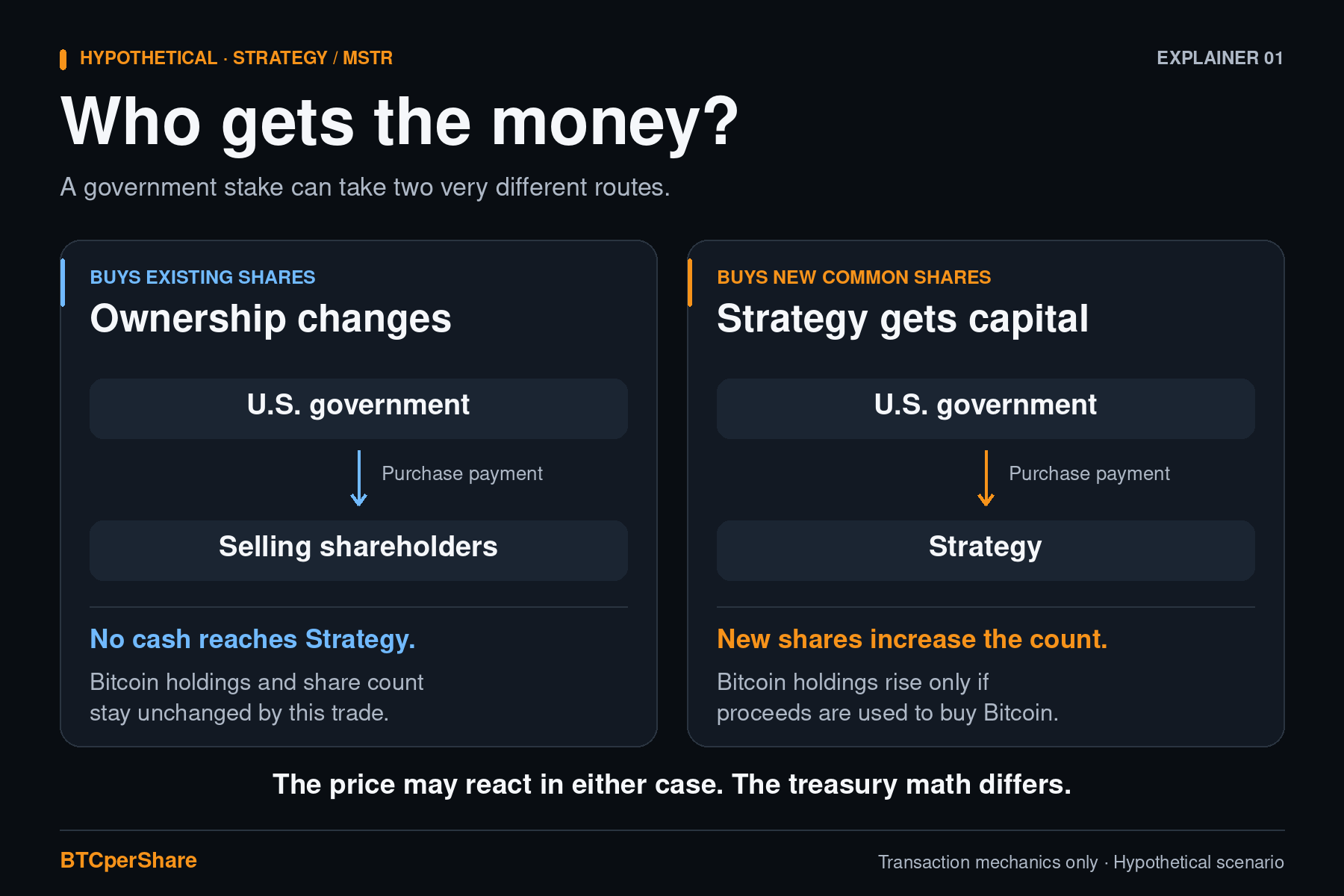
If Washington bought existing MSTR shares, the money would go to selling shareholders. Strategy would receive no proceeds from that trade. Its Bitcoin holdings and share count would remain unchanged.
If Washington bought newly issued common shares, Strategy would receive capital while its share count increased. Bitcoin holdings would rise only to the extent proceeds funded Bitcoin purchases. Cash retained for dividends, interest, or other purposes would not add Bitcoin.
The second effect could matter more
A government stake could encourage investors to pay a higher premium for MSTR’s Bitcoin exposure. If that premium persisted, Strategy could potentially raise more dollars per new share and use those dollars to buy more Bitcoin.
That is the interesting connection: a secondary purchase could have no immediate effect on BTC per share, yet improve the economics of later capital raises.
Consider a deliberately simplified company holding 100 BTC with 100,000 common shares. Each share represents 100,000 sats on this measure.
Now issue 10,000 additional shares. If the proceeds buy 20 BTC, holdings increase 20% while shares increase 10%. BTC per share rises about 9.1%. If the proceeds buy only five BTC, BTC per share falls about 4.5%.
The buyer’s identity does not change that arithmetic. The issue price, Bitcoin purchase price, and use of proceeds do.
A favorable price for the government could also mean an unfavorable price for existing shareholders. Discounted shares or warrants would deserve the same scrutiny as any other financing. A higher market valuation would help only if Strategy could actually raise capital on attractive terms.

Why wouldn’t Washington just buy Bitcoin?
This is the biggest hole in the bullish case.
The Strategic Bitcoin Reserve order established Treasury-controlled custodial accounts and directed officials to develop budget-neutral strategies for acquiring additional Bitcoin. A corporate wrapper is not necessary merely to avoid holding coins.
Buying MSTR would provide indirect exposure through a company with debt, preferred equity, and operating decisions. It would not transfer Strategy’s Bitcoin into the government’s reserve. Nor does the order establish a route for buying MSTR.
Washington would need a convincing policy reason to choose Strategy, plus appropriate authority and funding. The semiconductor and mineral precedents alone do not supply those answers.
What would shareholders give up?
The risk would depend on the rights negotiated alongside the investment.
U.S. Steel’s golden share gives Washington specific consent rights over matters including certain plant closures and headquarters changes. Those powers came from the deal’s terms; ordinary stock ownership does not automatically confer them.
For Strategy, restrictions on Bitcoin sales, financing, or distributions could reduce the flexibility shareholders value. An administration’s priorities could also change.
Nor should investors treat a government shareholding as a guarantee of Strategy’s debt or preferred dividends. Ownership and a payment guarantee are different commitments; any promised support would have to be established in the actual terms.
The Bitcoin-ethos concern belongs here, too. Government ownership would not give Washington control over Bitcoin’s protocol. It could create influence over a prominent company holding Bitcoin, a distinction worth preserving.
A government stake could be bullish for MSTR while offering shareholders an unattractive bargain. Before celebrating, read the price, the rights, and the use of proceeds. Then check what happened to Bitcoin per share.
BTCperShare analysis is for informational purposes only and is not financial advice or an offer to buy or sell any security.