Strive’s Warrant Cash Could Fund the SATS Dividend Runway
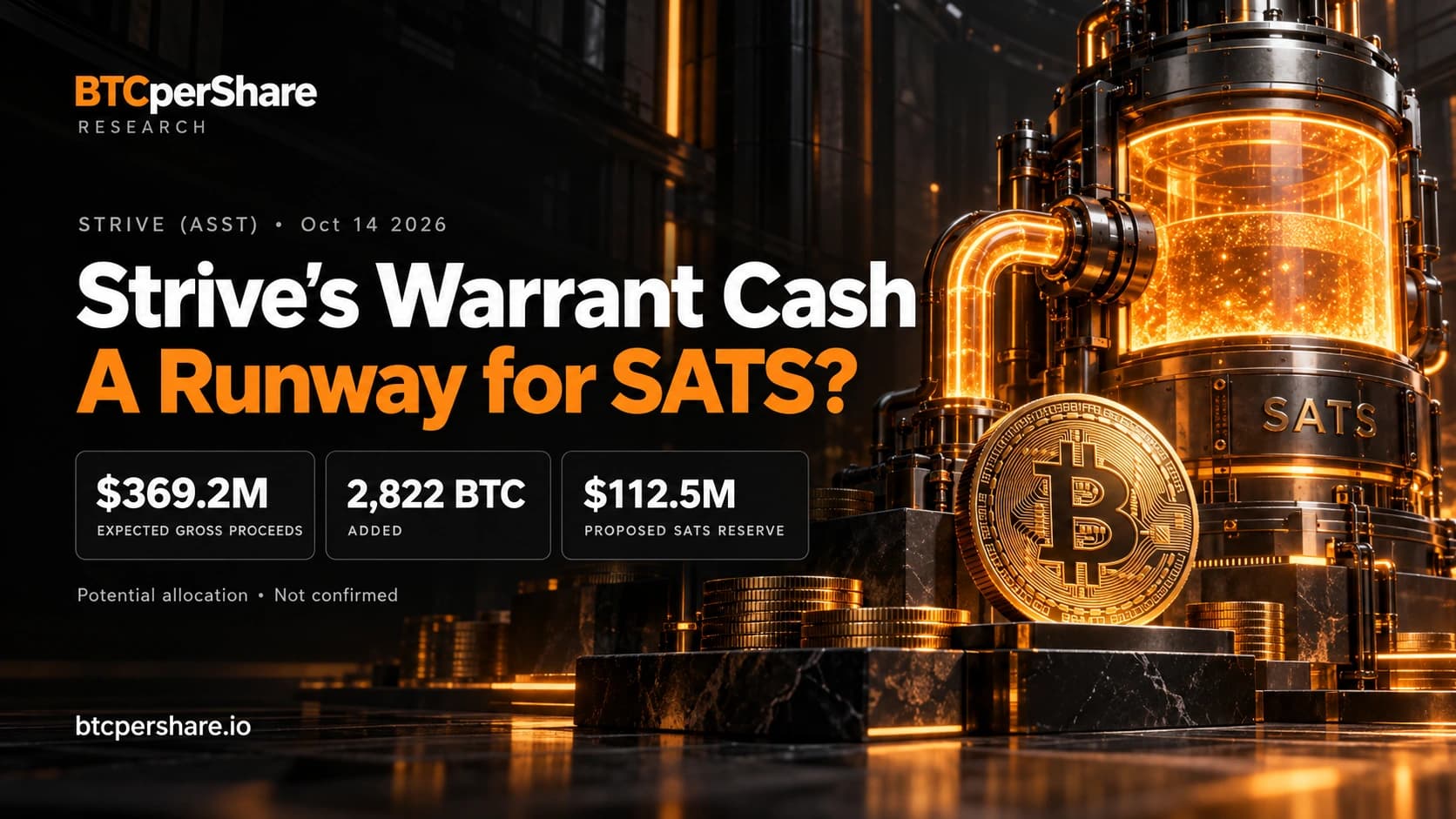
Strive bought another 2,822 bitcoin as its traditional warrants expired. The more interesting number may be the roughly $134 million difference between expected warrant proceeds and the cost of that purchase.
That amount could cover the entire initial dividend reserve for the proposed SATS offering. The filings support the possibility, although Strive has not confirmed that the warrant cash is earmarked for it.
The October 14 8-K reports warrant exercises for 13,674,703 common shares during October 12–13, generating expected gross proceeds of $369.2 million. Strive also purchased 2,822 BTC at approximately $83,266 each, including fees and expenses: roughly $235 million in total.
Adding that purchase to the October 9 balance brings holdings to 35,595 BTC. No traditional PIPE warrants remained outstanding at the October 13 close.
The reserve fits the cash gap
Strive’s SATS preliminary prospectus proposes five million preferred shares paying 15% annually on a $100 stated amount. That means $75 million in annual dividends and $112.5 million for the first 18 months.
At closing, Strive intends to increase its existing dividend reserve by $22.50 per SATS share, funding that increase with existing cash and securities.
The two announcements fit together:
| Illustrative allocation | Amount |
|---|---|
| Expected gross warrant proceeds | $369.2M |
| Less disclosed BTC purchase cost, approximately | ($235.0M) |
| Difference before other costs or uses | $134.2M |
| Proposed SATS reserve for five million shares | ($112.5M) |
| Remaining amount in this scenario | $21.7M |
The proposed reserve would absorb about 84% of that difference.
This is an allocation scenario, not a reported cash balance. The 8-K does not provide updated cash or designate money for SATS. Strive already reported $310.3 million in cash and approximately $50.3 million in STRC holdings as of October 9, alongside existing obligations. Cash is fungible; a numerical fit cannot establish management’s intent.
What ASST holders are paying for
The warrant exercises increased the common-share count faster than the disclosed purchase increased Bitcoin holdings.
Adding the exercised shares to October 9 effective common shares produces an estimated 124.1 million shares. On that basis, raw Bitcoin per share falls from approximately 29,689 sats to 28,691 sats, a decline of 3.36%.
That estimate assumes no other share changes; the new filing does not provide a complete ending capitalization table. Raw Bitcoin per share also excludes cash and preferred claims, so the decline is not a measure of the change in total shareholder value.
If Strive retains cash for SATS, common holders have accepted dilution partly to fund liquidity for the next capital raise. The reserve remains a company asset until spent, but those dollars cannot simultaneously buy Bitcoin.
A path back above 60% amplification
SATS could fund more Bitcoin without issuing common shares. Strive defines amplification as debt plus preferred notional divided by Bitcoin’s market value. Using 35,595 BTC, October 9 SATA notional of $1.403 billion and September 30 zero debt, the following scenarios assume SATS sells at $100, every gross dollar buys BTC before fees, reserves come from existing liquidity, and Bitcoin stays at the latest disclosed purchase price of $83,266:
| Scenario | BTC held | Amplification |
|---|---|---|
| Before SATS | 35,595 | 47.3% |
| $500M SATS offering | 41,600 | 54.9% |
| Hypothetical $1B upsize | 47,605 | 60.6% |
A $1 billion offering could therefore restore amplification above 60%, consistent with management’s stated objective while Bitcoin is below $100,000. Fees or cash retained from the offering would mean fewer BTC and higher ratios at the same Bitcoin price. Final pricing and allocation remain unknown; no $1 billion upsize has been announced in the sources reviewed.
The larger raise also doubles annual SATS dividends from $75 million to $150 million and the 18-month reserve from $112.5 million to $225 million. That reserve exceeds the $134.2 million warrant-proceeds gap by about $90.8 million, requiring additional existing liquidity to preserve the assumed Bitcoin deployment. More amplification increases common holders’ exposure to Bitcoin’s moves, alongside larger preferred claims and dividend costs.
Eighteen months buys time
The reserve could reduce near-term pressure to raise money or sell assets to meet dividends. Strive plans to invest it in instruments intended to preserve capital.
It remains company-managed, with no independent escrow arrangement. Dividends also remain subject to board declaration and legally available funds. After the initial 18 months, the prospectus anticipates funding cash dividends primarily through further capital raising.
For ASST holders, the next questions are the actual reserve allocation, final SATS terms and the Bitcoin acquired with the resulting capital. Those disclosures will show whether today’s dilution helped finance durable growth in Bitcoin backing per common share.