Strive Raises SATA to 13.25% as Shares Trade Below Par
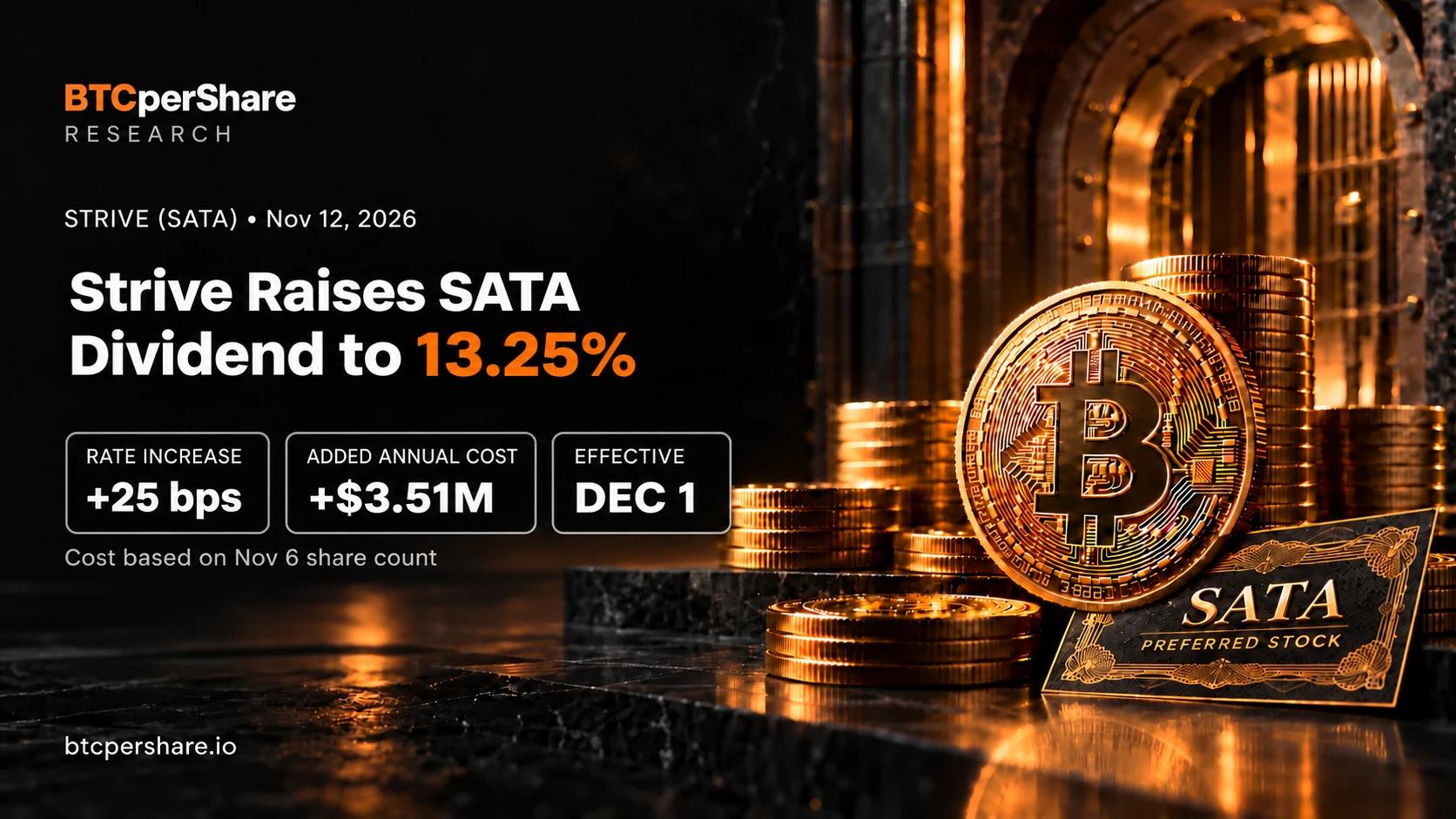
Strive is increasing SATA’s annual dividend rate from 13.00% to 13.25%, effective December 1. The move adds approximately $3.51 million to its annual preferred dividend bill at the latest disclosed share count.
The November 12 SEC filing arrives after several weeks of SATA trading below $100. Since Strive introduced its higher-paying SATS preferred, investors have had a new income alternative from the same issuer. A higher SATA payout improves that comparison, while increasing the cost borne by the business.
Another $3.5 million a year
Strive’s November 9 update reported 14,030,176 SATA shares and 7,036,559 SATS shares as of November 6.
The 25-basis-point increase adds $0.25 annually per SATA share, calculated on its $100 stated amount.
| Annualized dividend obligation | Before | After |
|---|---|---|
| SATA | $182.39M | $185.90M |
| SATS, unchanged at 15% | $105.55M | $105.55M |
| Combined | $287.94M | $291.45M |
That is approximately $292,000 more per month, or a 1.22% increase in the combined annual burden. These are calculated run rates using unchanged November 6 share counts and stated annual rates, excluding daily-payment rounding. They are not a forecast of actual payments over the next year.
For December, Strive declared $0.0502 per SATA share on each of 22 business days, totaling $1.1044. The smaller daily amount compared with November’s $0.0571 reflects more payment days: November has 19. The monthly payout increases.
SATA’s trading since SATS arrived
Strive announced SATS on October 13 and closed the offering on October 20.
SATA’s price history shows a choppier market around and after that launch:
| Date | SATA closing price |
|---|---|
| October 12, before the SATS announcement | $99.40 |
| October 14 | $97.67 |
| October 20, SATS offering closed | $98.75 |
| October 30 | $94.86 |
| November 11, before the rate announcement | $97.16 |
SATA also touched $94.58 intraday on October 30. Through November 11, its price was down approximately 2.25% from October 12 and 1.61% from October 20. Those are price changes; dividends improved holders’ total returns.
At the November 11 close, the existing $13 annual dividend represented a 13.38% current yield. The new $13.25 annual rate would produce approximately 13.64% at that same purchase price, assuming the rate remains unchanged. The announced 13.25% rate applies to the $100 stated amount, not every investor’s purchase price.
SATS changed the income comparison
SATS launched at $90, with a fixed $15 annual dividend. That produces a 16.67% simple annual yield at the offering price, before taxes and without reinvestment.
That was an obvious alternative for investors comfortable accepting more risk for more income. But SATS ranks below SATA for dividends and liquidation distributions. SATA offers seniority and a variable payout intended to help stabilize its price; SATS offers a fixed payout with greater exposure to price fluctuations.
There is also a benefit to SATA: Strive described the SATS issuance as adding junior capital beneath it. SATS can strengthen SATA’s position in the capital structure while competing for some of the same buyers.
Investor rotation into SATS is therefore a plausible contributor to SATA’s weakness. The timing alone does not prove it caused the decline.
Bitcoin risk still reaches the preferreds
Economically, these preferreds can be understood as bitcoin derivatives: their risk and value depend heavily on a company whose balance sheet is concentrated in bitcoin. Legally, SATA and SATS are preferred equity; “derivative” here describes that economic dependence, not a contractual bitcoin-linked payout.
A falling bitcoin price reduces the asset cushion supporting preferred claims. It can also weaken confidence in Strive’s ability to raise fresh capital, causing investors to demand higher yields and push preferred prices lower.
Bitcoin itself generates no cash dividend. Strive’s SATS prospectus says it expects to fund cash dividends primarily through additional capital raising. Reserves provide time, but do not eliminate that financing risk. Daily distributions also do not prevent capital losses.
The financing benefit depends on the share price
Strive’s October amendment prohibits new SATA sales below $100 before fees. Trading below that level constrains its use as a financing source.
Raising the dividend is consistent with Strive’s stated $99–$101 trading objective, although that range is not guaranteed. A sustained recovery to issuance levels could restore another route to financing bitcoin purchases without adding common shares.
The extra $3.51 million a year increases SATA holders’ income from December. For ASST holders, the payoff depends on whether that higher cost helps restore enough demand to make SATA productive financing again.